
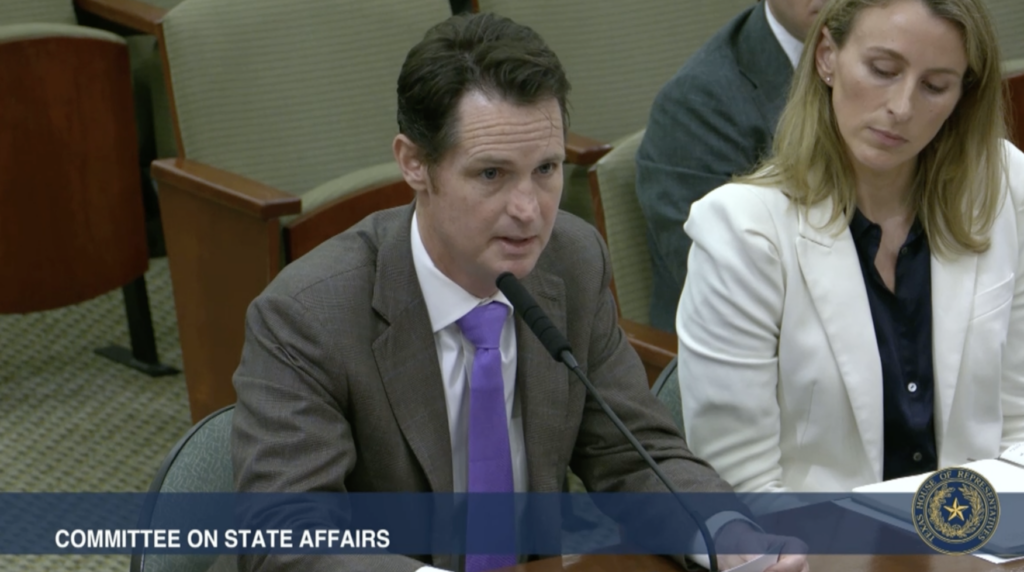
TEBA’s Marshall Coover was among the invited speakers on April 9 for a hearing of the Texas House State Affairs Committee on “the development of data centers in Texas, including its importance to global competitiveness and national security.” Marshall focused specifically on the new batch study process, which will help ERCOT review the unprecedented volume of load interconnection requests that the grid manager is now considering. Here’s what he said:
“Chairman, members, thank you for the opportunity to be here today.
My name is Marshall Coover, and I’m here on behalf of the Texas Energy Buyers Alliance. TEBA represents a broad coalition of energy consumers; from large-scale traditional manufacturers and heavy industry, to retailers and hyperscalers, to small “main street” businesses. These energy buyers all have distinct interests and energy use profiles, but one thing unites them all: dependence on abundant, low-cost, reliable electricity for their businesses to grow and thrive.
We believe that the unprecedented growth in demand for electricity is fundamentally a good thing for this state, and we support policies that maximize the attractiveness of Texas to industrial growth.
I’ll focus my comments on the implementation of the batch study process under Senate Bill 6, and specifically how the initial grouping of projects is defined.
We support the direction the Legislature took with SB 6. Bringing more structure and discipline to large load interconnection is a necessary step given the scale of growth Texas is experiencing.
One of the central themes of SB 6 is identifying “real” loads, and ensuring that we are planning and building our grid only to serve those projects that have the highest probability of coming online.
In our view, the most important opportunity in front of the Commission is to better align the batch study process with the work that has already been done through Regional Planning Groups, or “RPGs.”
RPG plans are ERCOT’s forward-looking blueprint for where transmission will be built to meet expected demand. They reflect load growth that utilities have identified and, in many cases, are already planning infrastructure to serve. That is one of the clearest signals available that a project is real and that the system is preparing for it.
Today, the proposed criteria for inclusion in the initial batch rely heavily on traditional indicators of project readiness. Those are useful, but they are not the only way to distinguish between projects.
If a project is already embedded in RPG planning, that reflects a level of system-level validation that should carry weight in how the initial batch is constructed.
Without that alignment, we risk creating a disconnect between two parts of the system that are intended to work together—transmission planning on one hand, and load interconnection on the other.
In practical terms, that could mean infrastructure is moving forward based on expected load, while the projects associated with that load are delayed by process. That is not an efficient outcome, and it is not consistent with how Texas has historically approached growth.
More broadly, the goal of SB 6 implementation should be to introduce discipline without introducing unnecessary delay.
Large customers understand that they have a responsibility to demonstrate seriousness and to bear appropriate costs associated with interconnection.
At the same time, we recognize that the profile of these new large loads is different, and that it is appropriate for policy to evolve alongside that reality. That is why we have also proposed the concept of a minimum required transmission payment for new large loads—an approach that represents a shift in practice, but one that helps ensure the transmission system is being paid for by those who are using it.
What customers need in return is a process that is predictable, aligned with existing planning, and capable of moving at the pace of real investment.
Texas has built a reputation as a place where infrastructure and investment can move in step. As we implement SB 6, the objective should be to preserve that alignment while improving how we plan.
Recognizing RPG-aligned projects as a valid pathway for inclusion in the initial batch is a practical way to do that. It builds on work that has already been done, reflects real planning commitments, and helps ensure the system remains coordinated rather than fragmented.
The growth we are seeing is an opportunity. The question is whether our processes will allow us to capture it efficiently and responsibly.
We believe the batch study process overall can do that, if it is implemented in a way that keeps planning and execution aligned.
Thank you, and I look forward to your questions.”