
Demand for power in Texas is growing so fast that the state’s grid operator, ERCOT, is inventing a totally new way to process the unprecedented number of requests from new loads for grid interconnections: a new batch study process.
Our state’s grid and economy have an enormous amount riding on how it shakes out.
ERCOT is exploring the process because its load interconnection queue has grown to an eye-popping 410 gigawatts of proposed projects.
To put that in perspective, ERCOT’s all-time demand record is a little over 85 gigawatts.
Not all of those projects are going to be built, but a lot of them will. And gauging the impact they’ll have on the grid has become a central challenge for the grid operator.
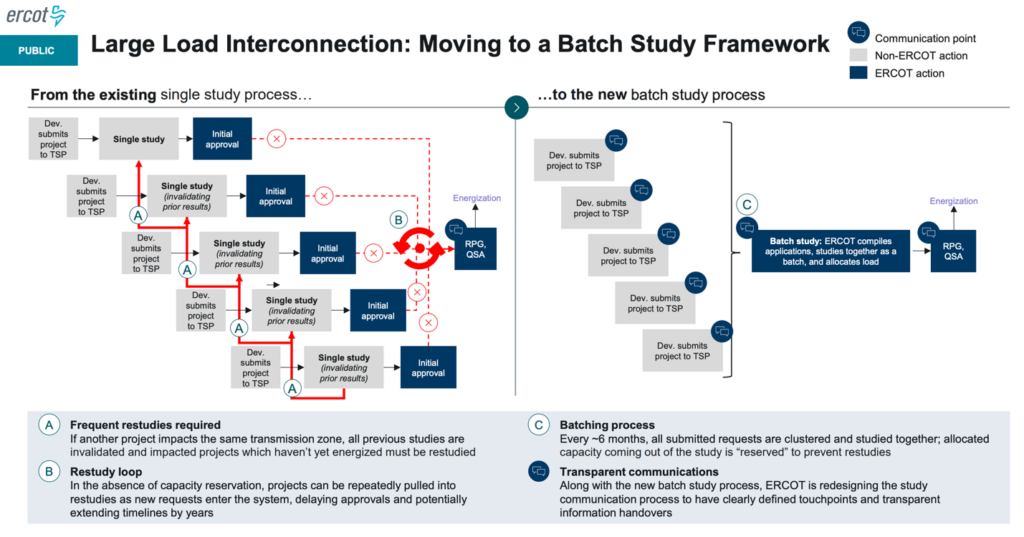
In the past, ERCOT reviewed projects individually. The spiking number of queued projects means that approach is now too time-consuming and involves too many variables. The grid needs a faster, more efficient process for studying and approving interconnection requests, so that ready-to-go projects can move forward without getting mired in a years-long backlog or repeated re-study cycles.
In response, ERCOT wants to evaluate projects in batches. Done right, this could accelerate the timeline for bringing new load and generation online.
Done wrong, however, it could needlessly stall projects, hampering the Texas economy in the process.
Getting to Batch Zero
The first — and most critical — batch is called Batch Zero. This is the first group of large-load projects that ERCOT would evaluate as part of the batch process. Projects that don’t make the cut could spend years waiting to interconnect to the grid.
ERCOT has established three pathways to be included in the Batch Zero group, looking at issues such as whether assessments are complete, equipment is ordered, site prep is underway, or interconnection agreements are signed. These standards reflect ERCOT’s attempt to prioritize projects that are genuinely ready to move.
But the approach has gaps.
Most importantly, we believe ERCOT is overlooking a logical pathway to determining which projects are included in Batch Zero: loads that have already been planned for through existing Regional Planning Group (RPG) transmission projects.
Texas utilities are already planning for these projects, which represent dozens of gigawatts of planned loads; utilities have already developed transmission improvements to serve them through the RPG process.
Some of these loads may be included in Batch Zero through other pathways, but they could be forced to wait for years without electricity if they don’t make the cut, leaving such facilities unable to function.
Given that transmission is the most critical bottleneck to interconnection, this doesn’t make sense. These projects are coming. They should be included in ERCOT’s studies as soon as possible.
Huge Batch Zero Stakes
The stakes of missing Batch Zero are enormous.
ERCOT has signaled that under the new process, it would not begin evaluating future batches of large-load projects until the Batch Zero evaluations are complete. Projects that don’t qualify initially could have to wait until 2032 or later to interconnect.
That timeline cuts against Texas’s pro-growth, pro-business identify — particularly as the state competes for major economic and job-creation investments. We’re known for our competitive energy market, friendly regulatory environment, and power grid that’s easy to plug into.
The last thing we need is a system that forces critical, real and ready economic development projects to languish in red tape.
With the right interconnection process — and the right mix of projects in Batch Zero — we can make sure our economy keeps growing, and Texas remains the nation’s energy leader.
You can read TEBA’s comments on the batch study process here and here.